 Add to Chrome
 Add to Firefox
 Add to Edge
Learning to Reason in 13 Parameters
Feb 04, 2026
Recent research has shown that language models can learn to \textit{reason}, often via reinforcement learning. Some work even trains low-rank parameterizations for reasoning, but conventional LoRA cannot scale below the model dimension. We question whether even rank=1 LoRA is necessary for learning to reason and propose TinyLoRA, a method for scaling low-rank adapters to sizes as small as one parameter. Within our new parameterization, we are able to train the 8B parameter size of Qwen2.5 to 91\% accuracy on GSM8K with only 13 trained parameters in bf16 (26 total bytes). We find this trend holds in general: we are able to recover 90\% of performance improvements while training $1000x$ fewer parameters across a suite of more difficult learning-to-reason benchmarks such as AIME, AMC, and MATH500. Notably, we are only able to achieve such strong performance with RL: models trained using SFT require $100-1000x$ larger updates to reach the same performance.

ReasonCACHE: Teaching LLMs To Reason Without Weight Updates
Feb 02, 2026Can Large language models (LLMs) learn to reason without any weight update and only through in-context learning (ICL)? ICL is strikingly sample-efficient, often learning from only a handful of demonstrations, but complex reasoning tasks typically demand many training examples to learn from. However, naively scaling ICL by adding more demonstrations breaks down at this scale: attention costs grow quadratically, performance saturates or degrades with longer contexts, and the approach remains a shallow form of learning. Due to these limitations, practitioners predominantly rely on in-weight learning (IWL) to induce reasoning. In this work, we show that by using Prefix Tuning, LLMs can learn to reason without overloading the context window and without any weight updates. We introduce $\textbf{ReasonCACHE}$, an instantiation of this mechanism that distills demonstrations into a fixed key-value cache. Empirically, across challenging reasoning benchmarks, including GPQA-Diamond, ReasonCACHE outperforms standard ICL and matches or surpasses IWL approaches. Further, it achieves this all while being more efficient across three key axes: data, inference cost, and trainable parameters. We also theoretically prove that ReasonCACHE can be strictly more expressive than low-rank weight update since the latter ties expressivity to input rank, whereas ReasonCACHE bypasses this constraint by directly injecting key-values into the attention mechanism. Together, our findings identify ReasonCACHE as a middle path between in-context and in-weight learning, providing a scalable algorithm for learning reasoning skills beyond the context window without modifying parameters. Our project page: https://reasoncache.github.io/
Beg to Differ: Understanding Reasoning-Answer Misalignment Across Languages
Dec 27, 2025Large language models demonstrate strong reasoning capabilities through chain-of-thought prompting, but whether this reasoning quality transfers across languages remains underexplored. We introduce a human-validated framework to evaluate whether model-generated reasoning traces logically support their conclusions across languages. Analyzing 65k reasoning traces from GlobalMMLU questions across 6 languages and 6 frontier models, we uncover a critical blind spot: while models achieve high task accuracy, their reasoning can fail to support their conclusions. Reasoning traces in non-Latin scripts show at least twice as much misalignment between their reasoning and conclusions than those in Latin scripts. We develop an error taxonomy through human annotation to characterize these failures, finding they stem primarily from evidential errors (unsupported claims, ambiguous facts) followed by illogical reasoning steps. Our findings demonstrate that current multilingual evaluation practices provide an incomplete picture of model reasoning capabilities and highlight the need for reasoning-aware evaluation frameworks.
What's in Common? Multimodal Models Hallucinate When Reasoning Across Scenes
Nov 05, 2025Multimodal language models possess a remarkable ability to handle an open-vocabulary's worth of objects. Yet the best models still suffer from hallucinations when reasoning about scenes in the real world, revealing a gap between their seemingly strong performance on existing perception benchmarks that are saturating and their reasoning in the real world. To address this gap, we build a novel benchmark of in-the-wild scenes that we call Common-O. With more than 10.5k examples using exclusively new images not found in web training data to avoid contamination, Common-O goes beyond just perception, inspired by cognitive tests for humans, to probe reasoning across scenes by asking "what's in common?". We evaluate leading multimodal language models, including models specifically trained to perform chain-of-thought reasoning. We find that perceiving objects in single images is tractable for most models, yet reasoning across scenes is very challenging even for the best models, including reasoning models. Despite saturating many leaderboards focusing on perception, the best performing model only achieves 35% on Common-O -- and on Common-O Complex, consisting of more complex scenes, the best model achieves only 1%. Curiously, we find models are more prone to hallucinate when similar objects are present in the scene, suggesting models may be relying on object co-occurrence seen during training. Among the models we evaluated, we found scale can provide modest improvements while models explicitly trained with multi-image inputs show bigger improvements, suggesting scaled multi-image training may offer promise. We make our benchmark publicly available to spur research into the challenge of hallucination when reasoning across scenes.
AbstentionBench: Reasoning LLMs Fail on Unanswerable Questions
Jun 10, 2025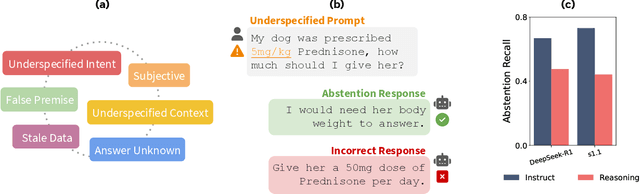

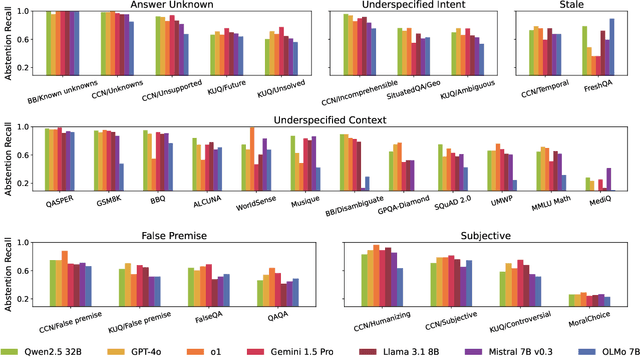
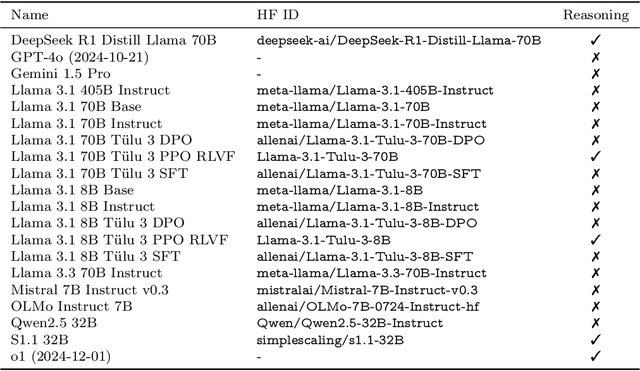
For Large Language Models (LLMs) to be reliably deployed in both everyday and high-stakes domains, knowing when not to answer is equally critical as answering correctly. Real-world user queries, which can be underspecified, ill-posed, or fundamentally unanswerable, require LLMs to reason about uncertainty and selectively abstain -- i.e., refuse to answer definitively. However, abstention remains understudied, without a systematic evaluation framework for modern LLMs. In this work, we introduce AbstentionBench, a large-scale benchmark for holistically evaluating abstention across 20 diverse datasets, including questions with unknown answers, underspecification, false premises, subjective interpretations, and outdated information. Evaluating 20 frontier LLMs reveals abstention is an unsolved problem, and one where scaling models is of little use. While recent reasoning LLMs have shown impressive results in complex problem solving, surprisingly, we find that reasoning fine-tuning degrades abstention (by $24\%$ on average), even for math and science domains on which reasoning models are explicitly trained. We find that while a carefully crafted system prompt can boost abstention in practice, it does not resolve models' fundamental inability to reason about uncertainty. We release AbstentionBench to foster research into advancing LLM reliability.
Joint Embedding vs Reconstruction: Provable Benefits of Latent Space Prediction for Self Supervised Learning
May 18, 2025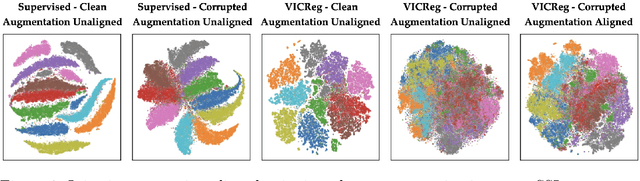

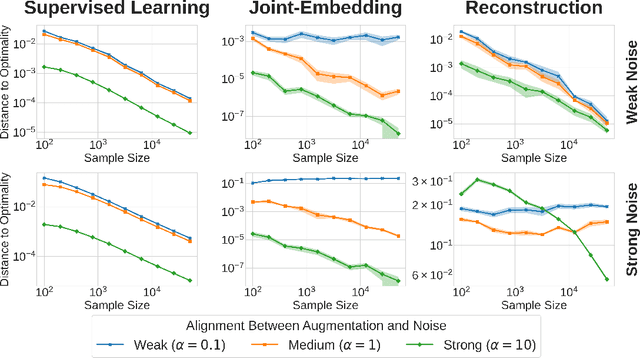
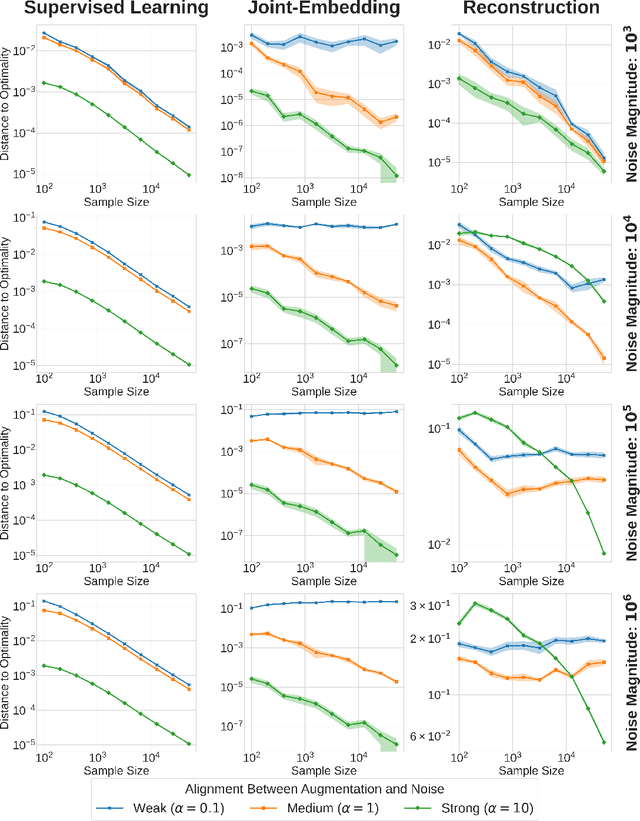
Reconstruction and joint embedding have emerged as two leading paradigms in Self Supervised Learning (SSL). Reconstruction methods focus on recovering the original sample from a different view in input space. On the other hand, joint embedding methods align the representations of different views in latent space. Both approaches offer compelling advantages, yet practitioners lack clear guidelines for choosing between them. In this work, we unveil the core mechanisms that distinguish each paradigm. By leveraging closed form solutions for both approaches, we precisely characterize how the view generation process, e.g. data augmentation, impacts the learned representations. We then demonstrate that, unlike supervised learning, both SSL paradigms require a minimal alignment between augmentations and irrelevant features to achieve asymptotic optimality with increasing sample size. Our findings indicate that in scenarios where these irrelevant features have a large magnitude, joint embedding methods are preferable because they impose a strictly weaker alignment condition compared to reconstruction based methods. These results not only clarify the trade offs between the two paradigms but also substantiate the empirical success of joint embedding approaches on real world challenging datasets.
EvalGIM: A Library for Evaluating Generative Image Models
Dec 18, 2024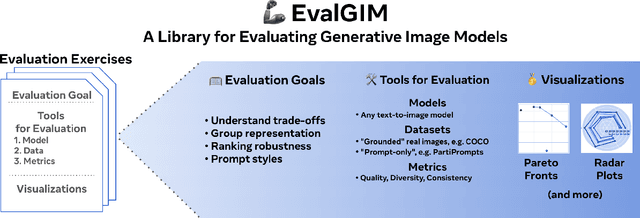


As the use of text-to-image generative models increases, so does the adoption of automatic benchmarking methods used in their evaluation. However, while metrics and datasets abound, there are few unified benchmarking libraries that provide a framework for performing evaluations across many datasets and metrics. Furthermore, the rapid introduction of increasingly robust benchmarking methods requires that evaluation libraries remain flexible to new datasets and metrics. Finally, there remains a gap in synthesizing evaluations in order to deliver actionable takeaways about model performance. To enable unified, flexible, and actionable evaluations, we introduce EvalGIM (pronounced ''EvalGym''), a library for evaluating generative image models. EvalGIM contains broad support for datasets and metrics used to measure quality, diversity, and consistency of text-to-image generative models. In addition, EvalGIM is designed with flexibility for user customization as a top priority and contains a structure that allows plug-and-play additions of new datasets and metrics. To enable actionable evaluation insights, we introduce ''Evaluation Exercises'' that highlight takeaways for specific evaluation questions. The Evaluation Exercises contain easy-to-use and reproducible implementations of two state-of-the-art evaluation methods of text-to-image generative models: consistency-diversity-realism Pareto Fronts and disaggregated measurements of performance disparities across groups. EvalGIM also contains Evaluation Exercises that introduce two new analysis methods for text-to-image generative models: robustness analyses of model rankings and balanced evaluations across different prompt styles. We encourage text-to-image model exploration with EvalGIM and invite contributions at https://github.com/facebookresearch/EvalGIM/.
Transformers Can Navigate Mazes With Multi-Step Prediction
Dec 06, 2024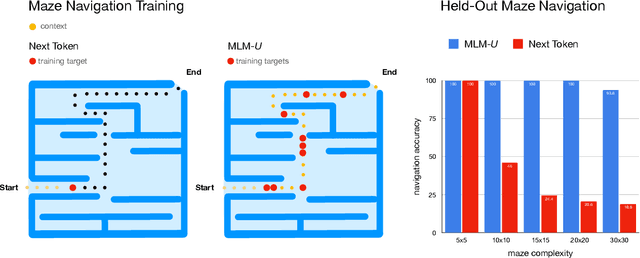

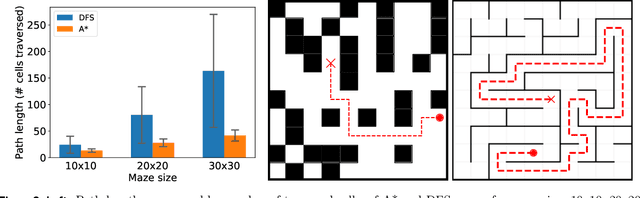
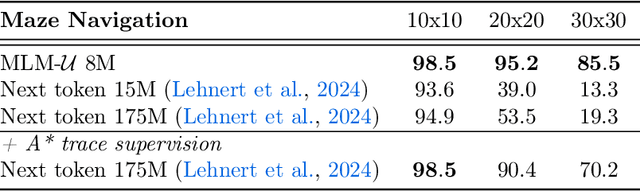
Despite their remarkable success in language modeling, transformers trained to predict the next token in a sequence struggle with long-term planning. This limitation is particularly evident in tasks requiring foresight to plan multiple steps ahead such as maze navigation. The standard next single token prediction objective, however, offers no explicit mechanism to predict multiple steps ahead - or revisit the path taken so far. Consequently, in this work we study whether explicitly predicting multiple steps ahead (and backwards) can improve transformers' maze navigation. We train parameter-matched transformers from scratch, under identical settings, to navigate mazes of varying types and sizes with standard next token prediction and MLM-U, an objective explicitly predicting multiple steps ahead and backwards. We find that MLM-U considerably improves transformers' ability to navigate mazes compared to standard next token prediction across maze types and complexities. We also find MLM-U training is 4x more sample efficient and converges 2x faster in terms of GPU training hours relative to next token training. Finally, for more complex mazes we find MLM-U benefits from scaling to larger transformers. Remarkably, we find transformers trained with MLM-U outperform larger transformers trained with next token prediction using additional supervision from A* search traces. We hope these findings underscore the promise of learning objectives to advance transformers' capacity for long-term planning.
UniBench: Visual Reasoning Requires Rethinking Vision-Language Beyond Scaling
Aug 09, 2024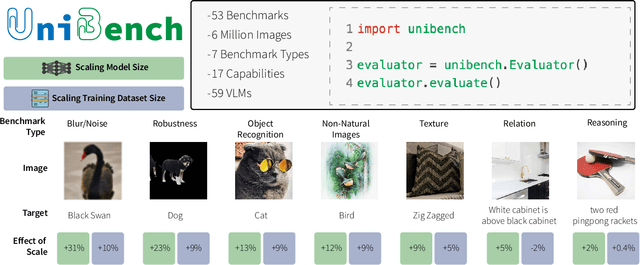
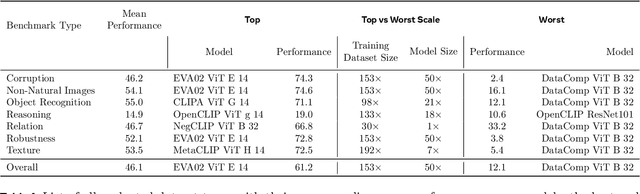
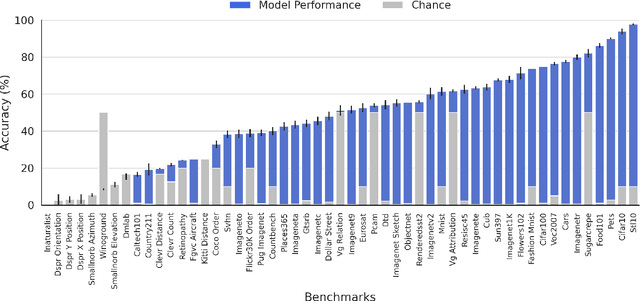
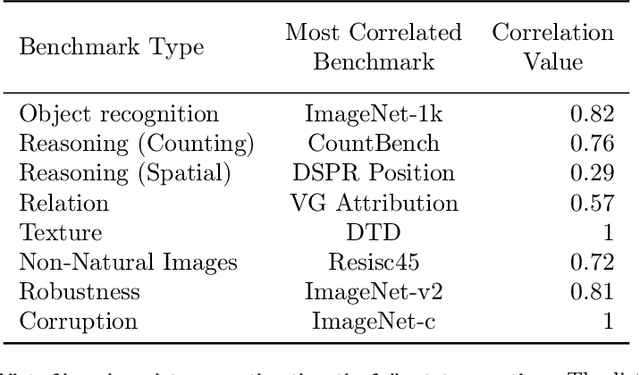
Significant research efforts have been made to scale and improve vision-language model (VLM) training approaches. Yet, with an ever-growing number of benchmarks, researchers are tasked with the heavy burden of implementing each protocol, bearing a non-trivial computational cost, and making sense of how all these benchmarks translate into meaningful axes of progress. To facilitate a systematic evaluation of VLM progress, we introduce UniBench: a unified implementation of 50+ VLM benchmarks spanning a comprehensive range of carefully categorized capabilities from object recognition to spatial awareness, counting, and much more. We showcase the utility of UniBench for measuring progress by evaluating nearly 60 publicly available vision-language models, trained on scales of up to 12.8B samples. We find that while scaling training data or model size can boost many vision-language model capabilities, scaling offers little benefit for reasoning or relations. Surprisingly, we also discover today's best VLMs struggle on simple digit recognition and counting tasks, e.g. MNIST, which much simpler networks can solve. Where scale falls short, we find that more precise interventions, such as data quality or tailored-learning objectives offer more promise. For practitioners, we also offer guidance on selecting a suitable VLM for a given application. Finally, we release an easy-to-run UniBench code-base with the full set of 50+ benchmarks and comparisons across 59 models as well as a distilled, representative set of benchmarks that runs in 5 minutes on a single GPU.
$\mathbb{X}$-Sample Contrastive Loss: Improving Contrastive Learning with Sample Similarity Graphs
Jul 25, 2024


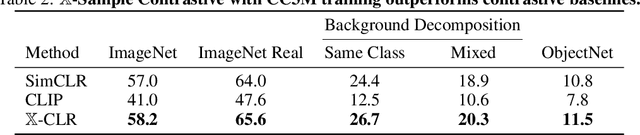
Learning good representations involves capturing the diverse ways in which data samples relate. Contrastive loss - an objective matching related samples - underlies methods from self-supervised to multimodal learning. Contrastive losses, however, can be viewed more broadly as modifying a similarity graph to indicate how samples should relate in the embedding space. This view reveals a shortcoming in contrastive learning: the similarity graph is binary, as only one sample is the related positive sample. Crucially, similarities \textit{across} samples are ignored. Based on this observation, we revise the standard contrastive loss to explicitly encode how a sample relates to others. We experiment with this new objective, called $\mathbb{X}$-Sample Contrastive, to train vision models based on similarities in class or text caption descriptions. Our study spans three scales: ImageNet-1k with 1 million, CC3M with 3 million, and CC12M with 12 million samples. The representations learned via our objective outperform both contrastive self-supervised and vision-language models trained on the same data across a range of tasks. When training on CC12M, we outperform CLIP by $0.6\%$ on both ImageNet and ImageNet Real. Our objective appears to work particularly well in lower-data regimes, with gains over CLIP of $16.8\%$ on ImageNet and $18.1\%$ on ImageNet Real when training with CC3M. Finally, our objective seems to encourage the model to learn representations that separate objects from their attributes and backgrounds, with gains of $3.3$-$5.6$\% over CLIP on ImageNet9. We hope the proposed solution takes a small step towards developing richer learning objectives for understanding sample relations in foundation models.